
Pillow-end embroidery becomes a small framed work
Walls and shelves with embroidered pillow ends: choosing background colors and breathing space
How can embroidered pillow ends be appreciated like small framed artworks?
For embroidered pillow ends already separated from their pillows and circulating independently, first choose a quiet background and breathing space around the pattern. Do not dismantle or cut an intact old pillow. Check the back as well as the front, and confirm the installation method.
- Choose backing color and space first, revealing a small surface on a narrow wall or shelf
- Keep intact old pillows unharmed; check front and back condition and installation method
2026.10.19 · Antique stories
Some walls feel too narrow for a large painting yet too plain with photographs alone—above an entry console or beside a bookcase. An embroidered pillow-end panel can be enjoyed there like a small artwork. Threads and patterns gathered on small fabric give a reason to look closely without filling a broad wall.
Here we consider embroidered pillow-end panels already separated from pillows and in circulation. They are a type of old household object to ask about at Dapsimni Antique Market; specific shops’ availability, stock, and prices are unverified. Do not dismantle or cut an intact old pillow for decorative material.
Decoration once placed at a pillow's ends
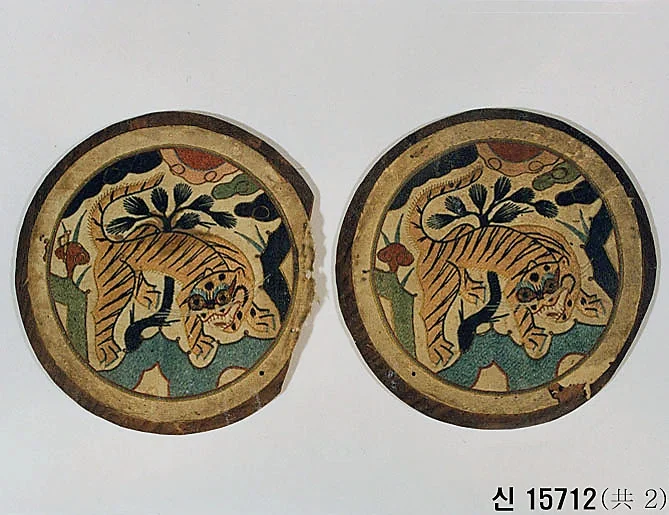
The National Institute of Korean Language’s Onyongeo describes pillow-end panels as decorations applied to both ends of a pillow. Methods include covering small wooden boards with embroidered cloth; materials and forms are not limited to one type.[1]
The National Museum of Korea holds a Joseon-period “자수 베겟모” (Embroidered Pillow End), listed as silk textile, 14.6 cm in diameter. The same museum separately registers wooden pillow ends. The name alone does not mean all pillow ends have embroidered faces or wooden interiors.[2][3]
A pillow-end panel’s appeal lies in the care devoted to decorating a small end of bedding. Today, that small surface can be appreciated independently. Resemblance to a museum example does not establish the same date. Ask whether it is old embroidery, a modern reproduction, or an old ground newly embroidered or repaired.
For a living room, choose the backing before the embroidery colors
For embroidered pillow-end panels, choose the backing color before the frame decoration. Try warm gray-white or pale beige for work containing reds, yellows, and other colors. Check that the patterns do not disappear into the ground and leave space to show the edges.
In a living room with dark wooden cabinets, compare slim black frames with light, plain ones. Choosing a color that connects to nearby modern furniture lets you avoid changing the whole space to a traditional style. There is no need to repeat the embroidery's colors with gold edging and elaborate mats.
Decide how to display the embroidery after checking its condition. The Canadian Conservation Institute advises leaving space so that the embroidery is not pressed against glass, and framing it with stable support and conservation-appropriate materials. Stretching it taut for appearance and supporting it safely are different matters. Consult a textile conservator about securing old fabric.[4]
At the entryway's side wall; away from books you take out in the study
In an entryway, look first at the wall beside the console rather than directly behind the door. Avoid places shaken by an opening door or brushed by bags, and secure the frame firmly to the wall. Even on a console, use a stable support and fixing method rather than simply leaning it against the wall. Places exposed to wet umbrellas or hand sanitizer are unsuitable.
In a study, a small independent wall is better than shelving where books are constantly removed and replaced. For one piece, find a viewing distance from your chair that reveals the thread direction and colors. For two side by side, try matching the outer frame sizes and background colors. This keeps the eye from scattering even if their shapes differ slightly. Do not, however, describe two unrelated pieces as an original pair.
Use soft lighting just strong enough to show the embroidery's relief. Do not bring a strong light close simply because the threads sparkle. Light damage to textiles depends on exposure time as well as intensity. Check when direct sunlight reaches the piece and turn the light off when it is not being viewed. Warm-color LEDs and UV-filtering glass do not prevent all light damage.[5]
In a café, separate functions rather than matching colors
In a café, choose a wall near seating, away from steam, grease, and splashed drinks, rather than behind the counter or coffee machine. A protective frame does not make every location suitable. Avoid places reached by sprays used to clean the wall too.
In rooms with gray walls and metal furniture, embroidery adds a small color accent. Rather than adding matching cushions and accessories, display one frame against a simple background. Keeping menus and notices away from its immediate sides makes small patterns easier to read.
On the label, give the name “embroidered pillow end” and only verified materials and dates. A short explanation, “decoration for the two ends of a pillow,” is enough for guests unfamiliar with its use. Do not assign meanings of good fortune or longevity to flowers or animals whose symbolism has not been verified.
The back’s condition matters as much as the front pattern
Before buying, check width and length or diameter, thickness, and the height of raised stitching. If already framed, measure the frame's outer dimensions, interior depth, and weight too. A large frame around a small pillow end is not necessarily wrong. Consider whether the space serves protection and visual breathing room or is purely decorative.
With the seller's guidance, examine front and back. Look for broken or lifting threads, tears in the backing fabric, worn edges, added cloth, and glue traces. If the back is concealed, request photos or records from before framing, without forcibly opening it on site. Ask about new stitching, replacement backing, cleaning, or dyeing too.
Mold, pest damage, powdering thread, tears, and adhesive residues require professional assessment before framing. Faded colors do not establish age, and vivid colors do not necessarily indicate a recent product.[4][5]
Do not rush to wash or iron it at home to straighten it, or fill missing patterns with new thread. Do not use adhesive lint rollers to remove dust or brush decorated areas. For everyday cushions or bedding decorations, choose modern pieces with washing and use instructions; reserve old pillow-end panels for display.[5]
You can begin planning a display with paper before touching the object. Cut paper to the expected sizes of the pillow-end embroidery and frame and hold them against the wall. Place possible backing colors alongside and check whether the pattern is visible from your usual walking distance. The small embroidery need not be made bigger; finding a place that invites a closer look is enough.