
A Place for the Openwork: Displaying a White Porcelain Brush Pot
Styling a study and living room around pierced walls and a low cylindrical form
How can I display the pattern of an openwork white porcelain brush pot clearly?
Leave space before a plain background instead of busy book spines, and adjust a light shining from the side. Avoid filling an antique pot with heavy stationery or putting a bulb inside. First check the rim and slender openwork for damage and repairs.
- Use a plain background so the net pattern does not overlap nearby outlines
- Use a stable surface and never lift it by hooking the delicate openwork
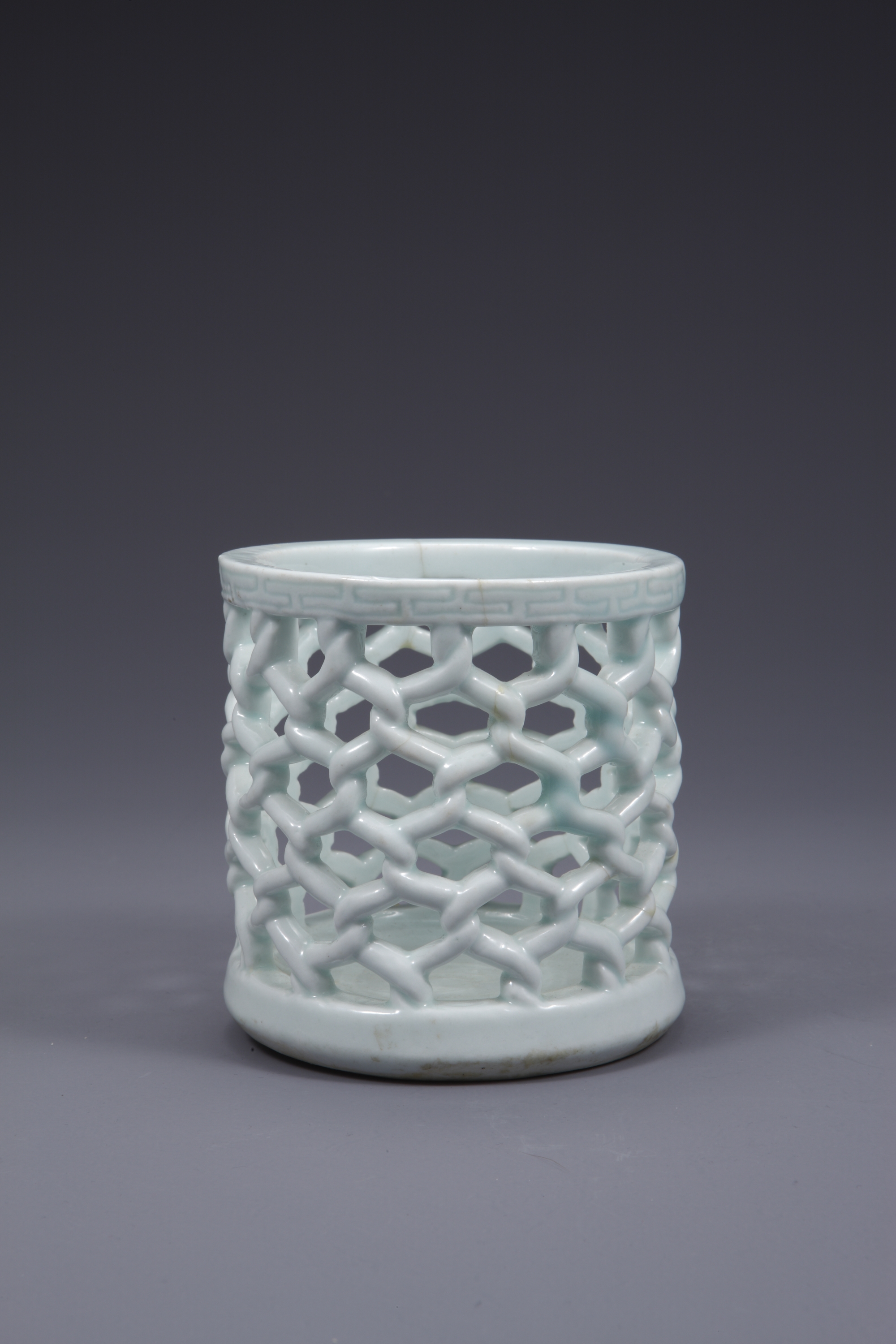
Stand a black book behind the brush pot and its white net pattern becomes distinct. Move the book aside and the wall and shelf appear through the openings. An openwork white porcelain pot changes with the colors and objects behind it. Clearing its background can do more than filling the desktop.
This article introduces a type of white porcelain brush pot worth looking for in Dapsimni Antique Market. Individual shops' stock and prices have not been verified. Understand its original purpose, but give an old pot a place where its walls can be appreciated rather than filling it with pens. For daily stationery storage, consider a modern craft piece with a known maker, production date and usage guidance.
From brush storage to an object of appreciation
A brush pot held brushes where people wrote or painted. Ryu Ju-hyeong's study of late-Joseon white porcelain brush pots describes their increasingly varied forms and decoration and their relationship with collecting and appreciating scholarly objects. This article consulted the public abstract on KCI, not the full paper.[1]
The National Museum of Korea's White Porcelain Brush Pot with Openwork Net Pattern, Dongwon195, is 10.9 cm high with a mouth diameter of 10.7 cm. The museum classifies it as Joseon white porcelain and describes slender strands intertwined into a net-like pattern. Its pale bluish-white glaze, cylindrical body and incised rim decoration can be viewed together.[2]
Not all white porcelain brush pots are pierced. The same museum's White Porcelain Brush Pot with Grape Design in Relief, Dongwon367, has raised grape leaves, fruit and stems across its body. Its recorded height and mouth diameter are both 13.5 cm. Openwork, viewed through its voids, and relief, viewed through surface contours, call for different display choices.[3]
Museum records offer comparisons of form. A similar-looking market object cannot automatically be assigned the same date or place of manufacture. Check the seller's account and its supporting evidence separately.
In a study, start with a plain background
Colorful book spines introduce different colors and lettering through every opening, making the pattern busy. Empty one shelf compartment or set a dark-gray file box farther behind the pot to provide a plain background. There is no need to attach a board to the object or lean the pot against a wall.
Gray or ink-black backgrounds define white porcelain on a light wooden desk. On black metal shelving, reduce nearby stationery rather than adding another pedestal. Books or document piles may raise the pot but will move when items are removed; a stable surface is preferable.
Avoid loading an antique brush pot with heavy scissors or metal pens. Tall contents hide its shape, and inserting or removing them may strike the interior and rim. Keep an everyday pen holder close at hand and place the openwork pot on a side shelf outside frequent hand movements.
Adjust the lighting angle in the living room
On a living-room sideboard, try just the brush pot and a low modern storage box. If white furniture and walls obscure its outline, place a dark object behind it with a gap rather than immediately beside it. Find a position where the openings do not overlap the edges of the background object.
Light it from the side, without putting a lamp inside. Turn a low LED desk lamp to see the decoration and shadows together. Shadow shapes depend on the openwork and light position, so begin with comfortable brightness instead of bringing the lamp very close for a crisp pattern. Do not alter the object to accommodate wires or a bulb.
For raised decoration such as grapes in relief, oblique light can reveal the contours. A display arrangement for pierced porcelain need not be applied to every white porcelain brush pot.
Keep it beyond passing hands in entrances and cafés
Reserve space for keys and mail on the entrance console first. Check whether the remaining inner area fully supports the pot; choose another location if bags brush past. An ink-dark background can work with a white console, while a dark wooden box set apart can accompany gray stone.
In a café, use a seating-area display cabinet rather than a counter pen or straw holder. Keep it away from the coffee machine and washing area, positioned so visitors can see its sides without rotating it. The Canadian Conservation Institute recommends reducing shock, vibration and unnecessary handling when displaying and storing ceramics.[4]
Label only the verified name, material and production date. Identify modern reproductions as modern, and use 'date unknown' when necessary. Do not place a museum object's accession number and date beside a café-owned piece as if they were the same object.
Examine the openings and rim slowly
Before purchase, check height, maximum diameter and base diameter. Do not assume a brush pot is the size of a small pencil holder: compare its actual dimensions with shelf depth. Ask the seller to assist with checking whether the base tilts or rocks.
Examine small rim chips, slender bridges between openings, then the body and foot. Ask about repair areas and materials if you see fills with different color or gloss, adhesive marks or joined seams. Photographs alone cannot reliably distinguish kiln traces from damage or repair. Do not tap it to test its sound or insert tools into the holes.
Never lift it with fingers hooked through the delicate openwork or rim. The Canadian Conservation Institute advises checking condition and past repairs before lifting ceramics and using both hands. Old adhesives may have weakened. Before cleaning, assess glaze, decoration and repairs; avoid bleach, acidic cleaners and improvised gluing.[4]
To finish, place the pot on an empty shelf and stand ink-black paper behind it without contact. Compare the same view with and without the paper, then choose. Clear away pens and cables. Once the openwork reads clearly, there is no need to add more decoration.
Photographic material
Original page and usage terms checked on October 25, 2026. The published image shows a museum reference object, not merchandise in Dapsimni.
| Original page | Caption for publication | Sources · Usage conditions |
|---|---|---|
| National Museum of Korea, White Porcelain Brush Pot with Openwork Net Pattern, Dongwon195 | White porcelain brush pot with net-like pierced walls and a low cylindrical body. Joseon; height 10.9 cm, mouth diameter 10.7 cm. National Museum of Korea, Dongwon195. | The individual page specifies KOGL Type 1: Attribution. Publication credits the institution, object name, accession number and original link. |
No separate interior-styling photographs were obtained. The arrangements are editorial suggestions, not reports of an actual visit or installation.
Sources for fact-checking
- Ryu Ju-hyeong, 'A Study on White Porcelain Brush Cases in the Latter Part of Joseon,' Journal of Cultural Relics 38 (2020), pp. 135–156. KCI bibliographic record and public abstract, DOI: 10.23117/jcr.2020.38.38.005. The public abstract was consulted for decoration and appreciation culture; the full paper was not reviewed.
- National Museum of Korea—White Porcelain Brush Pot with Openwork Net Pattern, Dongwon195: Material, period, dimensions, form and photograph usage terms.
- National Museum of Korea—White Porcelain Brush Pot with Grape Design in Relief, Dongwon367: Dimensions and an example of relief decoration distinct from openwork. This is a different object from Dongwon195 in the published photograph.
- Canadian Conservation Institute—Care of Ceramics and Glass, CCI Notes 5/1: Checking repairs before handling, storage that reduces vibration and shock, and guidance on cleaning, stain removal and professional repair.
No site visit, interview, authentication or dating of individual sale items, or unverified shop stock, prices or operating information is included.