
Blue Lines, Brown Lines: Reading Painted Ceramics
Distinguishing cobalt blue from iron brown by looking at pigment and body
How can I look at cobalt and iron decoration?
Cobalt decoration uses cobalt-based pigment; iron painting uses iron oxides. Check the ceramic body as well as colour, and do not date or authenticate an object by colour alone.
- Distinguish white porcelain from white-slipped buncheong
- Compare original images of objects combining both pigments
Follow a painted branch across a ceramic vessel and its line shifts between dark and pale. Blue decoration is often called cobalt blue, and brown or black decoration iron painting. The names become more useful when we ask what pigment was used and what lies beneath it.
What makes porcelain blue and white?
The Encyclopedia of Korean Culture describes blue-and-white porcelain as a white porcelain body painted with a cobalt-based pigment, glazed and fired at high temperature. It is better understood as a fired decoration beneath a glaze than as blue paint added to a finished white vessel.[1]
A deeper blue does not by itself mean an older or better object. The same reference explains that pigment composition, kiln conditions, temperature, clay and glaze all affect the result. In Dapsimni, observe the shading without treating one colour as proof of date or origin.[1]
Iron painting is not limited to white porcelain
Iron painting uses an iron-oxide-based pigment; after glazing and firing, the decoration appears black or dark brown. The Encyclopedia of Korean Culture notes its use on Goryeo celadon, buncheong and Joseon white porcelain. Calling every vessel with brown painting white porcelain overlooks the body beneath.[2]
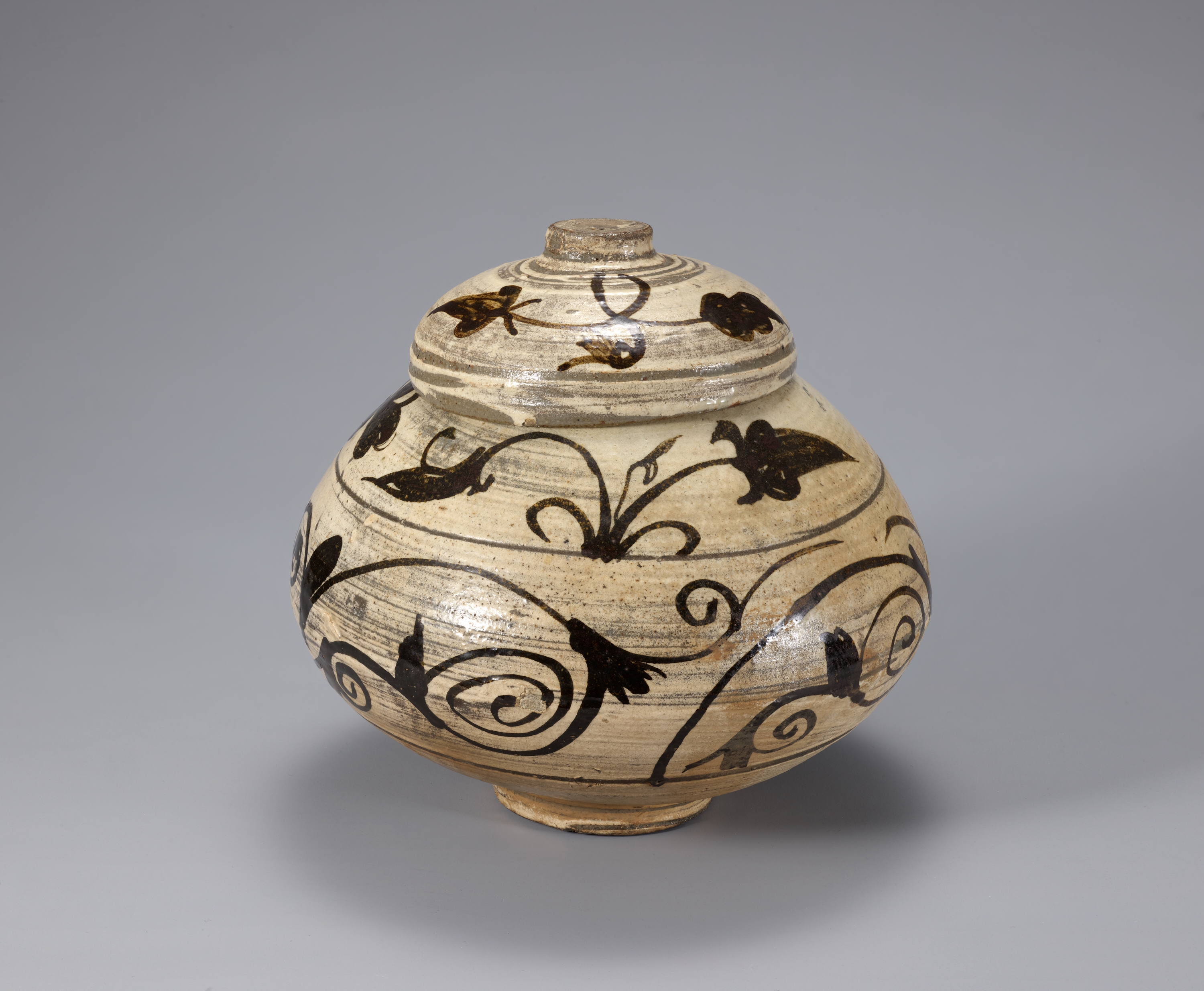
The photograph shows the National Museum of Korea’s Buncheong Jar with Vine Design in Iron Pigment, 덕수3376. The museum identifies it as buncheong painted in iron pigment over a white slip. Stems and leaves occupy the upper body, with simplified scrolling vines below. Its white surface and dark lines do not make it white porcelain.[3]
Two pigments can share one object
Nor must an object use only one pigment. Seoul Museum of Craft Art’s mountain-shaped water dropper combines cobalt and iron painting to depict a mountain. The museum dates it to nineteenth-century Joseon and identifies the form as Mount Geumgang. When two technique names appear in a title, compare where each colour is placed in the original photographs.[4]
One more question at the shop
If a seller labels an object blue-and-white porcelain, ask about its date, maker and supporting records. Resemblance to a museum piece does not establish a shared period. Blurred or dark passages are things to observe, not independent tests of authenticity. No shop stock or prices were verified for this article.
Contemporary makers also draw on blue-and-white traditions. Inchin Lee and Boram Choi’s study of modern adaptations discusses the reinterpretation of these techniques and styles. Only the public KCI abstract and bibliographic record were consulted here. A contemporary work with traditional decoration can be appreciated on its own terms when its maker and date are identified.[5]
Next time, choose one motif and follow it: where a stem branches into leaves, where the line thickens, where white remains. Then read the object’s name and material description. Looking first and checking the label afterwards can help you recognise the brushwork you enjoy.
Photographs and reuse conditions
Sources and reuse conditions checked on 26 October 2026. The published photograph shows 덕수3376, National Museum of Korea, under KOGL Type 1 (attribution), with the institution, object, number and original link credited. It does not show a Dapsimni sale item.
National Museum of Korea — Buncheong Jar with Vine Design, 덕수3376
The comparison photographs of the Seoul Museum of Craft Art water dropper carry KOGL Type 4 (attribution, noncommercial, no derivatives). They are not reproduced here; only the original page is linked below.
Sources
- Encyclopedia of Korean Culture — Cobalt decoration: process and colour
- Encyclopedia of Korean Culture — Iron painting: pigment and uses
- National Museum of Korea — Buncheong Jar with Vine Design, 덕수3376
- Seoul Museum of Craft Art — Mountain-shaped Water Dropper, CR-AA-00-000605
- Inchin Lee and Boram Choi (2014), A Study on the Modern Change of Blue and White Porcelain in the Joseon Dynasty, Art & Design 17(4), pp. 43–56. Public KCI abstract and bibliographic record only; full text not reviewed.