
A Place for Wooden Thread Winders and Their Carved Patterns
Displaying an old sewing tool in a shallow case at home or in a café
How can I display a wooden thread winder at home?
Lay it flat in a shallow case on a low shelf. Check length, width, thickness, lifting finish and repairs. Avoid using an old piece as a coaster or winding thread tightly around it.
- Choose low furniture with the top visible from your seat
- Avoid moisture and strong light; identify modern reproductions
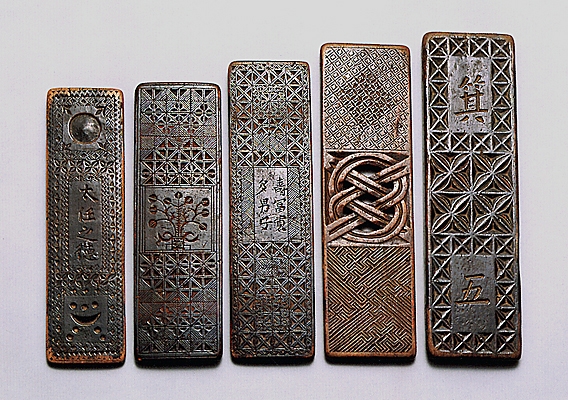
You do not need a large antique cabinet to bring an old household tool into view. Lay a flat wooden thread winder on a low sideboard. Its thin profile and carving are easier to see looking down at an angle than straight ahead. It suits a small area on a furniture surface.
This article introduces wooden thread winders as a type of object to look for in Dapsimni. No particular shop’s stock or prices have been verified. The proposed display preserves the form rather than turning an old winder into new storage.
A wooden tool for storing thread
The Encyclopedia of Korean Culture defines a thread winder as a small wooden piece for winding thread. Its examples range from long rectangular forms to waisted and cross-shaped ones, including plain wood and pieces decorated with mother-of-pearl or painted horn. These differ from the round spools beside a modern sewing machine.[1]
The National Museum of Korea’s Wooden Thread Winders, 신수15135, is a reference group containing several pieces. The museum classifies them as Joseon wood objects with floral motifs and inscriptions carved into thin boards. Do not assume the pieces share one size or assign the group’s listed measurements to a single winder.[2]
Sewing tools also inform contemporary design. Jaeho Lee and Seungchul Park’s study explores reinterpreting their forms as jewellery. Only the public abstract and bibliographic information were consulted here, not the full text. The following display ideas are editorial suggestions, not experimental findings from that study.[3]
Low in the living room, clear of working hands in the study
In the living room, choose a low sideboard whose top is visible from the sofa. Lay the winder flat in a shallow display case with space around it. Compare pale grey behind red or dark brown wood, or charcoal behind pale wood. Avoid direct contact with fabrics that may transfer dye or catch on the surface.
In the study, use a side shelf rather than the space beside the keyboard. Remove notes and charging cables, then align the long side with the shelf edge. On black metal shelving, try one piece in a single bay without adding several small stands. Lay it flat; balancing it on a thin edge or leaning it against a wall risks slipping.
Separate it from keys; add a cover in a café
At an entrance console, allocate space for keys and phones first. Put the winder in a covered case beside it, or choose another room if the surface is narrow. A flat shape does not make an old winder a coaster or key tray. Use a separate modern tray for daily storage.
In a café, a seating-area cabinet works better than the counter. A small label stating its use as a thread-winding tool and its verified material is enough. Keep menus out of the background and separate it from glasses, vases and coffee equipment. Side lighting can reveal carving without prolonged intense spotlighting.
Check the edges before winding anything around it
Before buying, check length, maximum width and thickness against the inside dimensions of the case. Look for split ends, warping, lifting finish and missing decoration. Ask about differently coloured fills, adhesive traces or refinishing. Wear and inscriptions alone do not establish age or the former owner’s status.
Do not tightly wind decorative coloured thread around an old piece or drill it to attach a cord. Identify modern reproductions by maker, date and material. If you need a working sewing tool, choose a separate contemporary product with suitable use instructions.
Canadian Conservation Institute guidance for furniture finishes recommends limiting light and moisture and checking the finish and its stability before cleaning. It discourages commercial polishes. These are useful principles for a small wooden tool too. If a finish powders or lifts, avoid rubbing and consult a conservator.[4]
To test a place today, cut paper to the winder’s outline and put it on a low shelf. It is a candidate if the top is visible when seated and hands rarely pass over it. Lay the actual object in a stable case, remove one nearby decoration, and stop when its outline and carved lines are readable.
Photographs and reuse conditions
Sources and image terms were checked on 26 October 2026. The photograph shows several pieces from National Museum of Korea group 신수15135, not Dapsimni sale stock or an actual interior installation. It is published under the object page’s KOGL Type 1 attribution terms, crediting institution, title, number and original link.
National Museum of Korea — Wooden Thread Winders, 신수15135: group, material, period and image licence
Individual thread-winder images in the Encyclopedia of Korean Culture are marked as unavailable for free reuse, so they are linked at the original page and not reproduced. No visit, interview or authentication of sale items is claimed.
Sources
- Encyclopedia of Korean Culture — Thread winder: uses and forms
- National Museum of Korea — Wooden Thread Winders, 신수15135: group, material, period and image licence
- Jaeho Lee and Seungchul Park (2012), A Study on Jewellery Using the Form of Traditional Sewing Tools, Journal of Digital Convergence 10(7), pp. 237–243. DOI: 10.14400/JDPM.2012.10.7.237. KCI public abstract and bibliographic record consulted; full text not reviewed.
- Canadian Conservation Institute — Care of Furniture Finishes, CCI Notes 7/2